VIVOTEK and March Networks at APTA 2026: Cameras, Video Analytics and Transit Safety
The APTA TRANSform Conference & EXPO 2026 is taking place at McCormick Place in Chicago, with the exhibition running October 5–7. For transit agencies, it is an opportunity to compare technology for vehicles, stations and depots. VIVOTEK and March Networks have announced demonstrations connecting cameras, recording, analytics and operational data. March Networks lists booth 3220; VIVOTEK is at booth 3858.
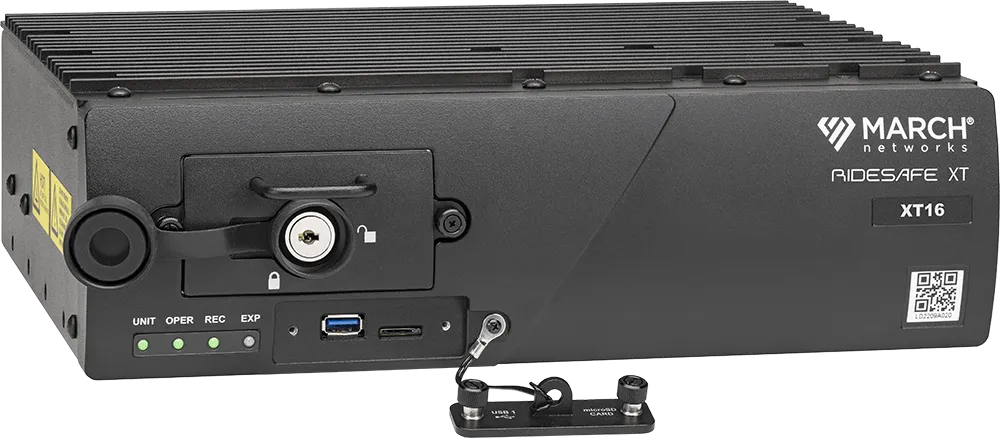
Cover image: official equipment photograph of a March Networks RideSafe XT recorder, not a photograph from APTA 2026. Courtesy of March Networks. Source: RideSafe product page; image hosted in the manufacturer's January 2025 media directory.
The companies' press release is dated October 1, 2026. This article reports the announced demonstration program, not an eyewitness account of what has been shown on the exhibition floor.
VIVOTEK: cameras for demanding transit environments
VIVOTEK contributes AI-powered IP cameras designed for transportation applications. The announcement covers onboard and fixed environments, including cabin and driver views, stations and other facilities. Its transportation and rolling-stock portfolios complement mobile recording rather than treating every vehicle as an isolated surveillance system.
For an operator, camera placement and image quality determine whether a recording helps explain an incident. A useful view of a passenger area is different from a driver-facing view, while a station entrance has different requirements again. The announcement does not name specific camera models or establish universal feature support. Hardware selection therefore still requires a model-by-model review.
The announced analytics include driver distraction and fatigue detection, passenger counting and occupancy analysis. These are described as capabilities within the combined offering—not functions available on every VIVOTEK camera. Their accuracy, processing location and integration requirements should be confirmed before an agency specifies them.
March Networks: recording, management and evidence
March Networks brings RideSafe mobile network video recorders, Command Enterprise Software and investigation tools. The stated aim is to manage footage across both fleets and fixed facilities, giving operators a more connected view of vehicles, stations and depots.
The program includes AI Smart Search and Attribute Search. Rather than reviewing every recording from beginning to end, an investigator can search by characteristics such as clothing color, vehicle type or other visual attributes. This may help narrow the footage relevant to an incident, but a search result is a starting point for review, not proof of identity or responsibility.
The portfolio also includes Searchlight Cloud and Evidence Vault for cloud-based intelligence and evidence management. Their inclusion in the announcement should not be read as confirmation that every deployment includes every service. Licensing, supported devices and the required software configuration remain project-specific questions.
Sleep Mode: when a vehicle is out of service
One announced demonstration concerns Sleep Mode, which can capture incidents while a vehicle is parked and powered down. That addresses a practical gap: risks do not disappear when a bus finishes its route.
The phrase does not mean recording without an energy source. Before deployment, an integrator should confirm the supported recorder, electrical installation, event triggers and operating limits. The release describes a capability, not a guarantee of continuous recording under every parked-vehicle condition.
Connecting video with operational context
Video can show what happened; GPS, telematics and other operational data can help explain where and under what conditions it happened. The companies describe connecting these sources to support investigations and fleet operations across mobile and fixed environments.
For example, reviewing a passenger incident alongside vehicle location could help an agency establish the sequence of events. That is an illustrative workflow, not a claim that a particular telematics platform is already integrated. Data availability, time synchronization and permissions must be checked during design. The release does not establish blanket ONVIF or API compatibility.
Why this matters to integrators
Our professional assessment is that the strongest opportunity lies in coordinating cameras, archives and analytics around an investigation workflow. Faster event discovery can be more valuable than adding another standalone camera, especially when relevant footage is distributed across vehicles and facilities.
For multi-site projects, centralized management may simplify evidence collection and oversight. Integrators should evaluate connectivity, retention, access controls and compatibility together, rather than promising universal support or guaranteed savings. Driver monitoring and passenger analytics also require careful attention to privacy and agency policies.
These are potential design benefits based on the announced portfolio. VADALEX is not claiming attendance at APTA 2026 or deployment of the solutions described.
Sources
- March Networks and VIVOTEK: official APTA 2026 press release, October 1, 2026.
- APTA EXPO: official event information.
- March Networks RideSafe recorders and original equipment photograph.
- VIVOTEK transportation solutions.
Verified photographs of the APTA 2026 booths and live demonstrations were not available for this article. The equipment image above is not exhibition reportage.